NFL Showdown $5,555,555 Super Bowl LV Millionaire · KC vs TB
NFL 2020 | Week 22 | Sun, Feb 07, 2021 | SUPER_BOWL
NFL Showdown $5,555,555 Super Bowl LV Millionaire · KC vs TB
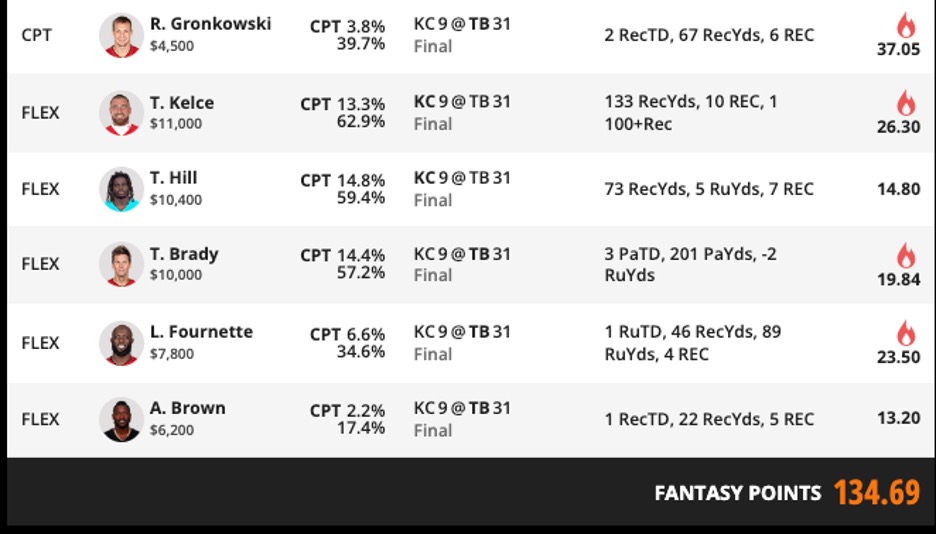
Winning lineup
| POS | PLAYER | OWN | SAL | PTS |
|---|---|---|---|---|
| CAPTAIN | Rob Gronkowski TB TE | 3.8% | 4500 | 37.05 |
| FLEX | Travis Kelce KC TE | 62.9% | 11000 | 26.3 |
| FLEX | Tyreek Hill KC WR | 59.4% | 10400 | 14.8 |
| FLEX | Tom Brady TB QB | 57.2% | 10000 | 19.84 |
| FLEX | Leonard Fournette TB RB | 34.6% | 7800 | 23.5 |
| FLEX | Antonio Brown TB WR | 17.4% | 6200 | 13.2 |
Analysis
Stack summary
This lineup won by identifying the precise Tampa Bay scoring concentration point the field did not captain often enough, then surrounding it with the most projectable volume from both teams. Rob Gronkowski at captain carried only 3.8 percent captain ownership, which was the slate’s true separator. Tampa Bay scored three passing touchdowns, and Gronkowski captured two of them. On a slate where the field naturally leaned toward quarterbacks and alpha wide receivers in the multiplier, the winning lineup shifted the captain slot to a touchdown dependent veteran tight end whose path looked narrower before kickoff than it did after the game settled.
The rest of the lineup stayed attached to the game’s most bankable production. Tom Brady handled every Tampa Bay passing touchdown. Leonard Fournette added the rushing score and strong receiving support. Antonio Brown closed the Tampa Bay side by taking the remaining receiving touchdown at only 17.4 percent flex ownership. On the Kansas City side, Travis Kelce and Tyreek Hill were less about uniqueness and more about preserving exposure to the Chiefs target concentration in a trailing script. Kansas City failed to score a touchdown, but Kelce still delivered enough receiving volume to remain necessary, while Hill kept the lineup tied to the most likely explosive Chief.
The diagnostic core is straightforward. This build won because it combined a fragile but correct captain thesis with extremely dense flex chalk from the game’s highest probability volume containers. It did not try to solve every branch of the game. It solved the captain slot, then used the flex positions to absorb the production the field was already correctly prioritizing.
Uniqueness notes
The captain choice carried almost all of the lineup’s leverage. Gronkowski at 3.8 percent captain ownership was the narrow gate this lineup passed through. Without that one decision, the construction collapses into a highly duplicated stars and scores shell. That matters here because the remaining five flex spots were all popular, and four of them came from the same Tampa Bay win script the field was already building around.
Antonio Brown was the secondary separator, though on a smaller level. At 17.4 percent flex ownership, he gave the lineup one more sub 20 percent roster spot and captured the third Brady passing touchdown. That kept the build from needing Chris Godwin or a more duplicated Tampa Bay piece. Even so, the overall ownership shape stayed extremely heavy and the lineup used only 100 in salary left, which did very little to reduce overlap in a contest this large.
The final grade lands at D. The lineup absolutely found the right captain leverage point, and that is why it won. But 781 duplicates on a Super Bowl showdown slate is a major structural penalty. This was a sharp captain attached to an otherwise very common body. For future lineup building, the lesson is clear. A low owned captain can still get swallowed by duplication when the flex shell is too obvious and the salary left is too small to create real separation.
Build details
Team split: 4-2
Build type: Low-owned tight end captain with four Tampa Bay pieces, two expensive Kansas City pass catchers, and one sub-20 percent flex touchdown scorer
Includes QBs: Yes
Primary lever: Rob Gronkowski captain created the slate’s only major leverage point through a 3.8 percent captain outcome
Secondary lever: Antonio Brown added a second low-owned touchdown path, but the flex shell remained highly duplicated because the rest of the build stayed close to the field’s preferred structure

Compare Your Lineup
Format
Screenshot uploaded
Winning lineup 134.69 PTS $49,900 SALARY 235.30% OWN
Comparison
Upload a screenshot to begin
Your lineup
Winning lineup
Difference
Click a Your Lineup value or edit parsed rows to complete the comparison.
Parsed rows
Total points
Pending extraction
134.69
—
Salary used
Pending extraction
$49,900
—
Total role ownership
Pending extraction
235.30%
—
Shared players
Pending extraction
Winning lineup only
—
Players you had that the winner did not
Pending extraction
Winning lineup only
—
Players the winner had that you did not
Pending extraction
Winning lineup only
—
Captain / MVP comparison
Pending extraction
Rob Gronkowski
—