NFL Showdown Monday Night Contest · DEN vs LAC
NFL 2022 | Week 6 | Mon, Oct 17, 2022 | MNF
NFL Showdown Monday Night Contest · DEN vs LAC
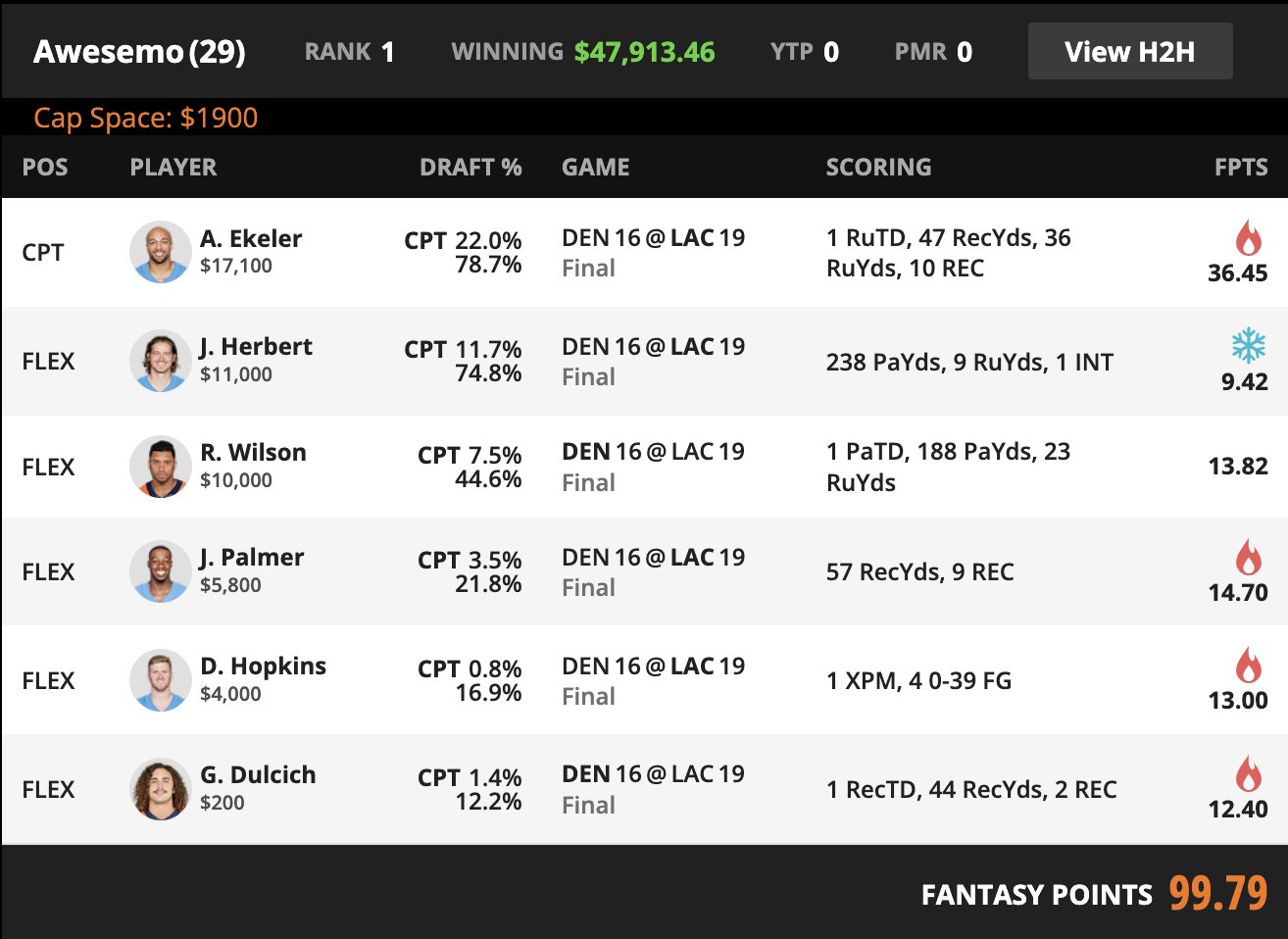
Winning lineup
| POS | PLAYER | OWN | SAL | PTS |
|---|---|---|---|---|
| CAPTAIN | Austin Ekeler LAC RB | 22.0% | 17100 | 36.45 |
| FLEX | Justin Herbert LAC QB | 74.8% | 11000 | 9.42 |
| FLEX | Russell Wilson DEN QB | 44.6% | 10000 | 13.82 |
| FLEX | Joshua Palmer LAC WR | 21.8% | 5800 | 14.7 |
| FLEX | Dustin Hopkins LAC K | 16.9% | 4000 | 13 |
| FLEX | Greg Dulcich DEN TE | 12.2% | 200 | 12.4 |
Analysis
Stack summary
This lineup won by treating the game as a narrow, ugly scoring environment where one elite touch earner could dominate without the quarterback room keeping pace. Austin Ekeler captain was not hidden at 22.0 percent captain ownership, though the way he got there mattered. He handled the Chargers touchdown equity, soaked up ten catches, and became the cleanest answer to a game where Los Angeles moved the ball without generating efficient quarterback scoring. That last point is the hinge. Justin Herbert made the lineup despite a poor fantasy result because Ekeler captain still needed access to the full Chargers possession volume, even if much of that volume died before it became quarterback ceiling.
The sharper layer came from the acceptance of bad offense as usable structure. Dustin Hopkins gave the lineup stalled drive scoring from the Chargers side. Greg Dulcich at 12.2 percent ownership gave the roster a near minimum salary Denver touchdown without forcing a dead punt. Russell Wilson was not good, though he was good enough to stay relevant because this slate did not require explosive quarterback scores. Joshua Palmer rounded out the build by catching short area volume in a game where the Chargers receiving tree was thinned out and Herbert spread empty calories toward one of the few available pass catchers.
Leaving 1,900 in salary mattered because the lineup did not need every dollar to capture the slate's scoring concentration. The roster identified a game where raw total points would stay low, touchdown distribution would be thin, and one cheap Denver bring back could unlock the exact construction needed around Ekeler.
Uniqueness notes
The strongest choice was Greg Dulcich at 200 salary and 12.2 percent ownership. That was the release valve that let the roster keep Ekeler captain, both quarterbacks, Palmer, and Hopkins while still leaving meaningful salary on the table. Dulcich was not a random click. He was a precise answer to a slate where Denver lacked trustworthy skill certainty and where one cheap touchdown could break the build structure.
The lineup also benefited from a form of negative leverage through Justin Herbert. He carried massive flex ownership and failed badly by showdown quarterback standards. Most Herbert lineups needed him to post a real ceiling. This one only needed him attached to Ekeler and Palmer while Hopkins and Ekeler absorbed the Chargers fantasy scoring. That is a subtler form of leverage than a low owned captain, though it still counts when the field overpays for a popular quarterback outcome that never arrives.
The final grade lands at B minus. The salary left, Dulcich, and the willingness to build around ugly offensive distribution gave the lineup real separation. It stops short of the upper range because Ekeler captain was still popular, Herbert was extremely popular, Palmer sat above 20 percent, and the overall shell remained understandable once the game played slow and thin.
Build details
Team split: 4-2
Build type: Popular running back captain with both quarterbacks, one midrange Chargers receiver, Chargers kicker, and a sub 15 percent minimum salary Denver tight end
Includes QBs: Yes
Primary lever: Greg Dulcich at 12.2 percent and 200 salary created the lineup's main structural separation by unlocking a salary path the field did not build often enough
Secondary lever: The roster treated Justin Herbert as a volume attachment rather than a ceiling requirement and let Ekeler plus Hopkins absorb most of the Chargers scoring

Compare Your Lineup
Format
Screenshot uploaded
Winning lineup 99.79 PTS $48,100 SALARY 170.90% OWN
Comparison
Upload a screenshot to begin
Your lineup
Winning lineup
Difference
Click a Your Lineup value or edit parsed rows to complete the comparison.
Parsed rows
Total points
Pending extraction
99.79
—
Salary used
Pending extraction
$48,100
—
Total role ownership
Pending extraction
170.90%
—
Shared players
Pending extraction
Winning lineup only
—
Players you had that the winner did not
Pending extraction
Winning lineup only
—
Players the winner had that you did not
Pending extraction
Winning lineup only
—
Captain / MVP comparison
Pending extraction
Austin Ekeler
—