NFL Showdown Thursday Night Contest · GB vs TEN
NFL 2022 | Week 11 | Thu, Nov 17, 2022 | TNF
NFL Showdown Thursday Night Contest · GB vs TEN
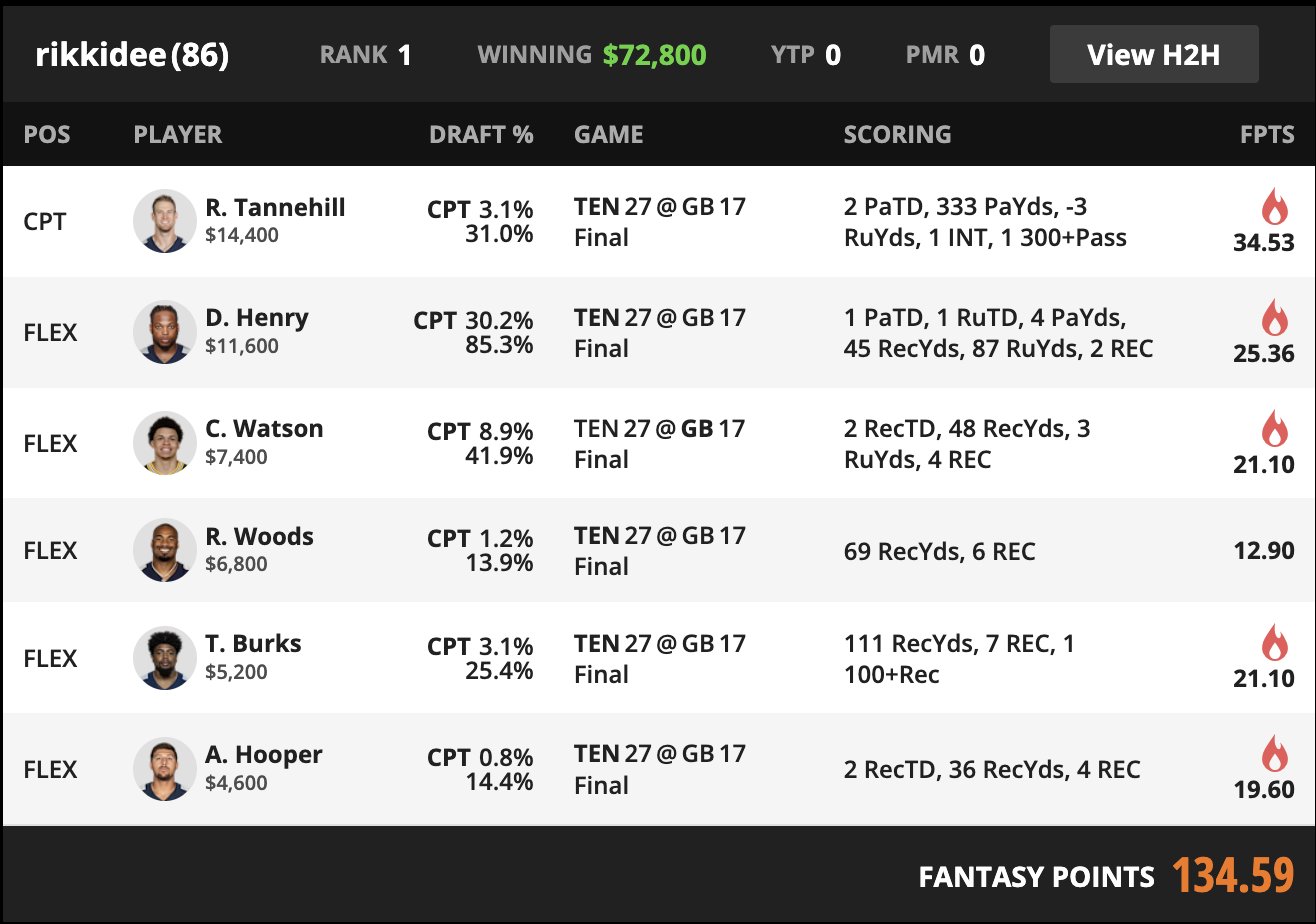
Winning lineup
| POS | PLAYER | OWN | SAL | PTS |
|---|---|---|---|---|
| CAPTAIN | Ryan Tannehill TEN QB | 3.1% | 14400 | 34.53 |
| FLEX | Derrick Henry TEN RB | 85.3% | 11600 | 25.36 |
| FLEX | Christian Watson GB WR | 41.9% | 7400 | 21.1 |
| FLEX | Robert Woods TEN WR | 13.9% | 6800 | 12.9 |
| FLEX | Treylon Burks TEN WR | 25.4% | 5200 | 21.1 |
| FLEX | Austin Hooper TEN TE | 14.4% | 4600 | 19.6 |
Analysis
Stack summary
This lineup won because it treated Tennessee's passing eruption as the slate's hidden ceiling instead of treating Derrick Henry as the only Titan worthy of the multiplier. Ryan Tannehill at 3.1 percent captain ownership was the decision point. The field was willing to play Henry and willing to use Tannehill in flex at modest rates, but very few lineups were built around a version of this game where Tennessee reached first place through quarterback efficiency and receiver concentration.
The build then pressed fully into that read. Derrick Henry stayed in because Tennessee's offense still ran through him, and his passing touchdown kept him tied to the same scoring environment. Robert Woods, Treylon Burks, and Austin Hooper completed a full Tennessee passing concentration bet. Once Tannehill threw for 333 yards and spread touchdowns across Burks and Hooper, with Woods adding volume underneath, the lineup captured nearly every profitable Titan pathway in one shell.
The Green Bay side stayed narrow. Christian Watson was the only bring back, and he was the correct one. Green Bay did not need a broader comeback stack because most of its useful fantasy output flowed through Watson's two receiving touchdowns. That single choice gave the lineup enough Packers exposure without wasting salary on lower impact Green Bay volume.
Using all 50,000 in salary did not hurt because the uniqueness came from captain and structure rather than from leftover salary. A 3.1 percent quarterback captain paired with four pass game teammates and Henry was already far from the field's preferred construction. This roster did not need artificial salary relief. It needed the correct read on where Tennessee's ceiling actually lived.
Uniqueness notes
The strongest trait here was conviction. Many lineups could reach Tannehill captain and still stop halfway by pairing him with one or two Titans. This build kept going. Four Tennessee flex spots around Tannehill created a full concentration thesis: if Tannehill broke the slate, most of the reward would remain inside a narrow Tennessee distribution. That is exactly what happened.
Robert Woods at 13.9 percent and Austin Hooper at 14.4 percent gave the lineup two sub 20 percent flex pieces beyond the low owned captain. Those were not dead salary savers. They were direct extensions of the Tannehill call. Burks then completed the stack with a stronger ceiling outcome, while Henry preserved access to the Titans offense in any form.
The grade lands at A minus. The lineup had elite captain leverage, two additional sub 20 percent flex pieces, a strong ownership shape, and a clear concentration build. It stops short of A plus because it used full salary and did not add a more uncomfortable tension element such as opposing defense or a lower probability secondary bring back. Still, this was a sharp, forceful first place structure.
Build details
Team split: 5-1
Build type: Low-owned quarterback captain with four same-team flex teammates and one opposing touchdown-focused bring back
Includes QBs: Yes
Primary lever: Ryan Tannehill captain created the lineup's main leverage point through a 3.1 percent captain outcome tied to concentrated Tennessee passing production
Secondary lever: Robert Woods and Austin Hooper added two sub 20 percent Titan pass catchers while Christian Watson served as the only Green Bay run back

Compare Your Lineup
Format
Screenshot uploaded
Winning lineup 134.59 PTS $50,000 SALARY 184.00% OWN
Comparison
Upload a screenshot to begin
Your lineup
Winning lineup
Difference
Click a Your Lineup value or edit parsed rows to complete the comparison.
Parsed rows
Total points
Pending extraction
134.59
—
Salary used
Pending extraction
$50,000
—
Total role ownership
Pending extraction
184.00%
—
Shared players
Pending extraction
Winning lineup only
—
Players you had that the winner did not
Pending extraction
Winning lineup only
—
Players the winner had that you did not
Pending extraction
Winning lineup only
—
Captain / MVP comparison
Pending extraction
Ryan Tannehill
—