NFL Showdown Monday Night Contest · KC vs PHI
NFL 2023 | Week 11 | Mon, Nov 20, 2023 | MNF
NFL Showdown Monday Night Contest · KC vs PHI
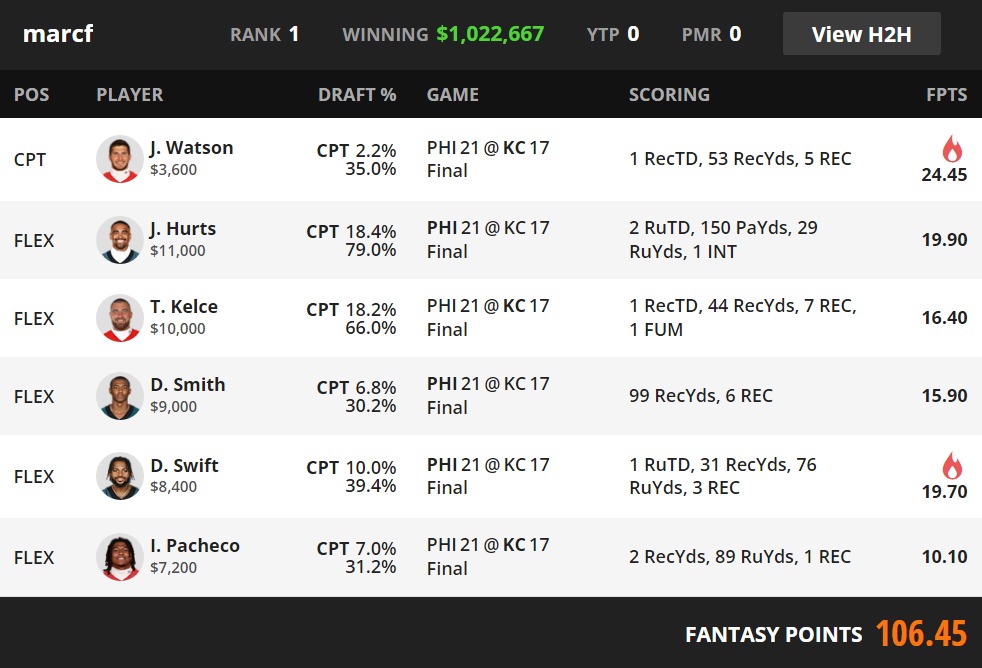
Winning lineup
| POS | PLAYER | OWN | SAL | PTS |
|---|---|---|---|---|
| CAPTAIN | Justin Watson KC WR | 2.2% | 3600 | 24.45 |
| FLEX | Jalen Hurts PHI QB | 79.0% | 11000 | 19.9 |
| FLEX | Travis Kelce KC TE | 66.0% | 10000 | 16.4 |
| FLEX | DeVonta Smith PHI WR | 30.2% | 9000 | 15.9 |
| FLEX | D'Andre Swift PHI RB | 39.4% | 8400 | 19.7 |
| FLEX | Isiah Pacheco KC RB | 31.2% | 7200 | 10.1 |
Analysis
Stack summary
This lineup won by taking the slate’s most explosive leverage point and placing it in the captain slot without compromising access to the game’s core scoring pieces. Justin Watson captain at 2.2 percent was the entire separator. In a game dominated by expensive names and quarterback-centric roster builds, the winning construction shifted the multiplier to a low-salary Kansas City receiver who could still access touchdown equity and enough yardage to break the slate.
The rest of the lineup stayed grounded in where fantasy production was most concentrated. Jalen Hurts remained necessary because Philadelphia’s offense ran directly through his rushing touchdowns. Travis Kelce still captured the most bankable Kansas City target concentration. DeVonta Smith and D'Andre Swift gave the build strong exposure to Philadelphia’s receiving and rushing output without forcing a more duplicated premium shell.
The sharper edge was the willingness to leave Patrick Mahomes off entirely while still betting on a Kansas City captain receiver. That is where the structure became uncomfortable enough to matter. The lineup was saying Kansas City could produce a winning captain through a secondary receiver while Mahomes himself failed to post a must-have score. That was the exact outcome the field was least prepared to build for at scale.
Isiah Pacheco completed the roster by covering Kansas City rushing production and preserving a balanced game environment. The build did not need one narrow script. It allowed Kansas City to generate enough offensive volume through multiple channels while still making Watson the central leverage point.
Because this lineup won a showdown Milly with a true low-owned captain and a quarterback omission the field rarely embraces cleanly, the structural result is top tier. Under your showdown grading rule, a Milly-winning showdown build is graded A plus.
Uniqueness notes
The defining choice was Justin Watson captain without Patrick Mahomes. That is not decorative uniqueness. That is a direct bet against the field’s default way of allocating Kansas City ceiling. Most rosters needed Mahomes to unlock a Kansas City pass catcher captain. This lineup did not.
The Philadelphia side of the construction stayed disciplined. Jalen Hurts, DeVonta Smith, and D'Andre Swift gave the lineup access to Philadelphia’s major production channels without overcommitting to a bloated Eagles stack. That balance mattered because the slate did not require a full one-sided interpretation.
Kelce and Pacheco also served distinct jobs. Kelce carried Kansas City receiving concentration. Pacheco carried ground volume and kept the lineup from becoming too fragile around one passing path. Once Watson hit captain, those two flex pieces gave the roster enough Kansas City stability without forcing Mahomes.
The final grade is A plus. The lineup won a showdown Milly, used a 2.2 percent captain, left salary on the table, and embraced a structurally uncomfortable Mahomes fade. Under the showdown grading rule, that result automatically qualifies as A plus.
Build details
Team split: 3-3
Build type: Low-owned Kansas City wide receiver captain without Patrick Mahomes, paired with Jalen Hurts, two Philadelphia skill players, Travis Kelce, and Isiah Pacheco
Includes QBs: No
Primary lever: Justin Watson captain created the slate’s main leverage point through a 2.2 percent captain outcome in a Mahomes fade construction
Secondary lever: The build balanced that leverage with Hurts, Kelce, Swift, Smith, and Pacheco to capture the game’s concentrated scoring without reverting to the field’s most duplicated premium structure

Compare Your Lineup
Format
Screenshot uploaded
Winning lineup 106.45 PTS $49,200 SALARY 280.80% OWN
Comparison
Upload a screenshot to begin
Your lineup
Winning lineup
Difference
Click a Your Lineup value or edit parsed rows to complete the comparison.
Parsed rows
Total points
Pending extraction
106.45
—
Salary used
Pending extraction
$49,200
—
Total role ownership
Pending extraction
280.80%
—
Shared players
Pending extraction
Winning lineup only
—
Players you had that the winner did not
Pending extraction
Winning lineup only
—
Players the winner had that you did not
Pending extraction
Winning lineup only
—
Captain / MVP comparison
Pending extraction
Justin Watson
—